
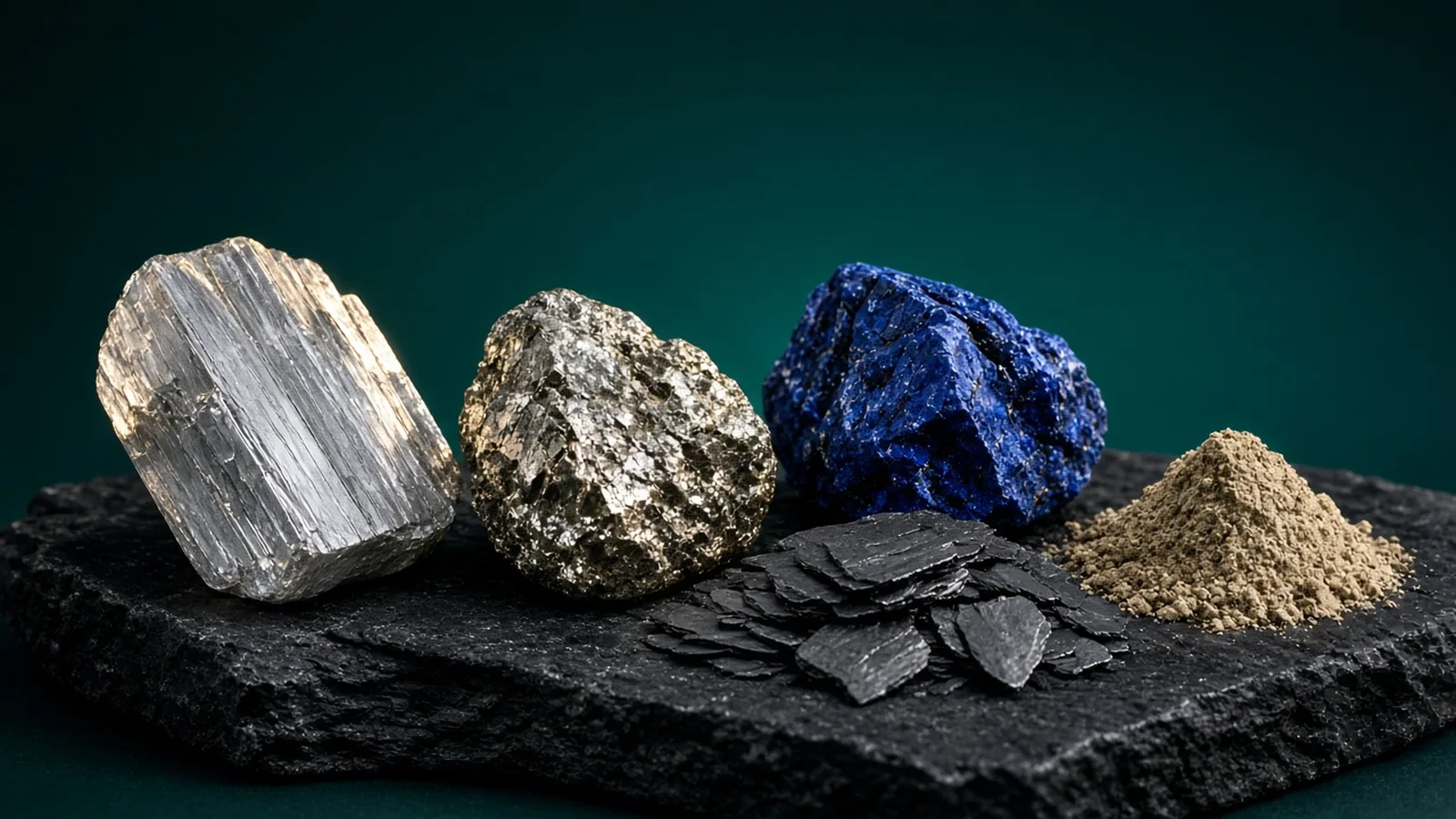
Critical Minerals Explained: Lithium, Nickel, Cobalt, Rare Earths and Graphite
"Critical minerals" are raw materials that are essential to modern economies and whose supply is exposed to disruption. Five stand out for the energy transition: lithium, nickel, cobalt, rare earth elements and graphite. Together they underpin batteries, electric motors, wind turbines and a growing range of electronics and defence technologies.
Why demand keeps rising
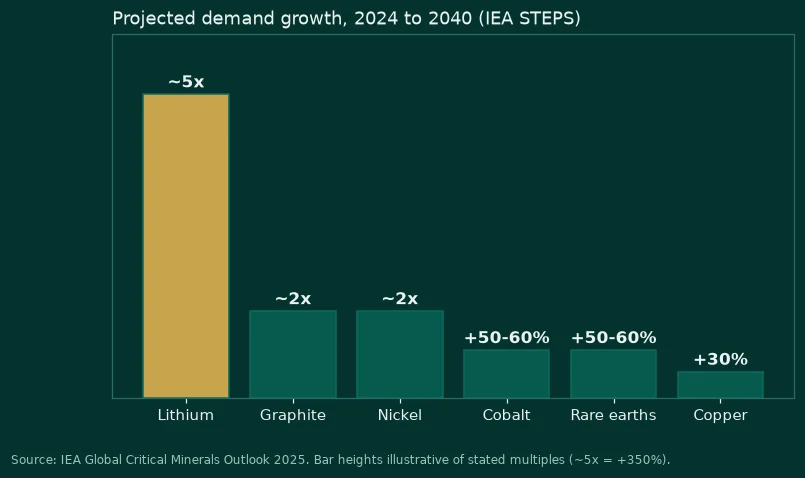
The IEA's Global Critical Minerals Outlook 2025 reports that lithium demand rose by nearly 30% in 2024, while demand for nickel, cobalt, graphite and rare earths grew 6-8%. Under today's policy settings (the Stated Policies Scenario), the IEA expects lithium demand to grow fivefold by 2040, graphite and nickel to roughly double, and cobalt and rare earths to rise 50-60%. Energy applications accounted for about 85% of demand growth for battery metals over 2022-2024.
The five minerals at a glance
Lithium
The defining battery metal. IEA data show demand of 205 kt in 2024, projected at 455 kt in 2030. After surging roughly eightfold in 2021-22, lithium prices fell by more than 80% from 2023 as new supply arrived, including from emerging producers such as Argentina and Zimbabwe.
Nickel
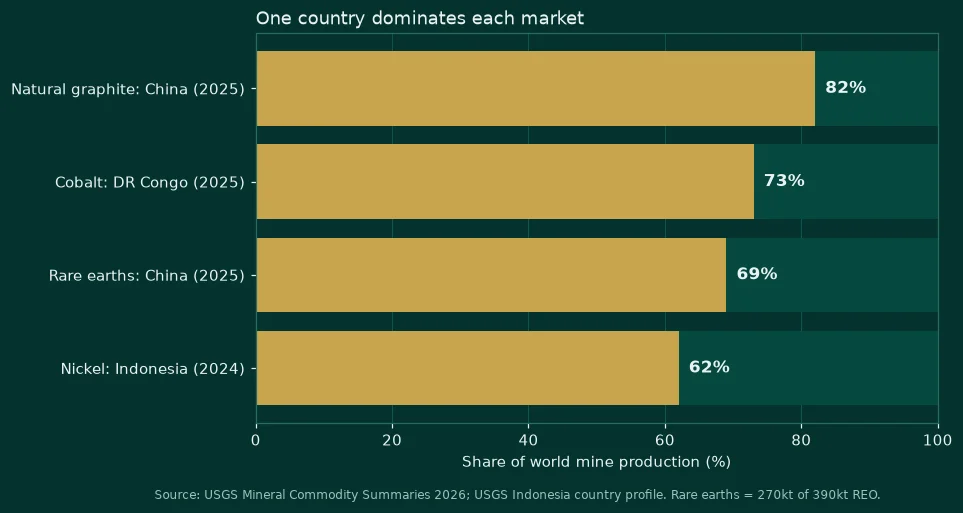
Used in stainless steel and high-energy battery cathodes. Indonesia was the world's leading mined nickel producer in 2024 with about 62% of global output, according to the USGS.
Cobalt
A cathode stabiliser and key input for superalloys. The USGS estimates DR Congo supplied about 73% of mined cobalt in 2025, followed by Indonesia at 14%. In 2025 DR Congo temporarily banned exports, then moved to quotas of up to 96,600 tonnes of contained cobalt per year for 2026 and 2027. Cobalt-free lithium iron phosphate chemistries now hold significant market share in China.
Rare earth elements
Neodymium and related elements are vital for the permanent magnets in EV motors and wind turbines. USGS figures put China's 2025 rare earth mine production at 270,000 tonnes REO out of a world total of about 390,000 tonnes, with an even larger role in separation and magnet manufacturing.
Graphite
The dominant anode material in lithium-ion batteries. China produced an estimated 82% of the world's natural graphite in 2025 (USGS), and trade measures on anode material have become a live policy issue.
Why it matters for industry
The common thread is concentration. When a single country accounts for two-thirds or more of supply, an export policy, a quota or an operational disruption can move global availability quickly. Price cycles are also sharp: the same rapid supply response that pushed battery metal prices down in 2024 can reverse when demand catches up.
For manufacturers, traders and investors, the practical response is diligence: understanding material specifications, chain-of-custody, logistics routes and the regulatory landscape in both producing and consuming markets.
Related products: Copper · Zinc · Aluminum
Planning requirements for this market? Share your specifications and our team will review your request.
Submit an RFQSources
- IEA, Global Critical Minerals Outlook 2025 - Executive summary – https://www.iea.org/reports/global-critical-minerals-outlook-2025/executive-summary
- IEA, Overview of outlook for key minerals – https://www.iea.org/reports/global-critical-minerals-outlook-2025/overview-of-outlook-for-key-minerals
- IEA, Lithium outlook tables – https://www.iea.org/reports/lithium-2
- USGS, Mineral Commodity Summaries 2026 - Cobalt – https://pubs.usgs.gov/periodicals/mcs2026/mcs2026-cobalt.pdf
- USGS, Mineral Commodity Summaries 2026 - Rare Earths – https://pubs.usgs.gov/periodicals/mcs2026/mcs2026-rare-earths_ver.1.2.pdf
- USGS, Mineral Commodity Summaries 2026 - Graphite – https://pubs.usgs.gov/periodicals/mcs2026/mcs2026-graphite.pdf
- USGS, Indonesia country profile – https://www.usgs.gov/centers/national-minerals-information-center/indonesia
Figures are cited from public sources for market context only and do not constitute an offer or price quotation.